
La PORTE — Making sure the county’s nonprofit leaders have the tools they need to be effective was the aim of a symposium hosted by the Health Foundation of La Porte.
Leaders from more than 40 county nonprofits came to connect and learn at the inaugural Nonprofit Excellence Symposium, “Leaders Learn,” on Jan. 27 at the HFL’s Conference & Learning Center.
HFL CEO Maria Fruth said the purpose was to present bite-sized information on how to run an effective and efficient nonprofit.
“The main purpose is capacity building. We are very interested in making sure that we give what I call the tools around the tool belt for each one of our nonprofits who are delivering incredible services in the community. A lot of them struggle with finances – they have to do fundraising…”
Founded in 2017, the HFL focuses on a mission of empowering county residents to live healthy and well through strategic thought leadership, grantmaking and capacity building efforts for nonprofits.
“We’re going to be giving grants. We want them to make sure they are utilizing other avenues through the foundation like this conference and learning center. They utilize quite a bit of the rooms here and it’s free of charge for the nonprofits,” Fruth said.
A lot of the nonprofit leaders attending are one-person shops, she said.
“Or they have a lot of volunteers – they need to coordinate to be able to deliver their services. We want to make sure they are delivering services in the highest level possible.”
During the day-long event, participants had the chance to learn from experts, network, collaborate and grow as leaders.
“A huge benefit is to bring everybody around the table to get to know their missions, to know how to collaborate and be aware … We have incredible services. It’s connecting the dots for them,” Fruth said.
The symposium began with a focus on self-care “… because we need to be taking care,” Fruth said. “There is a lot of passion among nonprofit leaders, and they tend to go way above and beyond any type of work because they care so much – they want to bring solutions, they want to solve issues.”
Psychotherapist and columnist Philip Chard served as the keynote speaker, discussing emotional intelligence, which he contrasted with “cognitive” intelligence.
“It’s different. It has to do with a person’s ability to use emotion to facilitate proper relationships and interactions,” he said.
Emotional intelligence or EQ, Chard said, has been shown to be the “be-all attribute” for being an effective leader.
“It’s number one on the list – it goes ahead of business acumen and technical skills, which you want to see in a leader, but if they don’t have emotional intelligence, those other things won’t carry the day.”
Chard said people tend not to remember a lot of basic information when they interact with others, but do remember how the other person makes them feel.
“How they make us feel is what drives our relationships, both in the workplace and personally, and has a tremendous impact on our capacity to influence other people and be effective in our organizations,” he said.
Likewise, Chard said, we remember what we felt about leaders – how they conducted themselves and how well they regulated their own emotions.
“That’s what the data tells us. Two-thirds, at least, of leader effectiveness is a function of their … emotional intelligence,” Chard said.
He called EQ a “secret sauce” that makes any leadership style work.
An optimal leader, he said, is a self-leader that is embedded in those they’re working with and also mindful. “They have that capacity to regulate their own behavior. They’re affiliative. They don’t stand apart. The people they lead, they work with them.”
Such leaders, Chard said, tend be more engaged in the present moment.
“Basically, if you’re not there, it’s pretty hard to be effective. If you’re thinking ahead too much or thinking behind too much, being present falls apart and you’re not engaged with people.”
A Harvard study showed that the higher one goes in the organization, the less likely they are to display EQ.
“The people who tend to show the most are line staff, supervisors and middle managers. Once you get above that level, it starts to go down,” Chard said.
“When we give people power and they perceive they have that, it changes them. They have to be aware of that change … and compensate,” he added.
Chard discussed the four components of EQ and how to increase them:
Self-awareness – being aware of what we’re feeling and how emotions are influencing behavior
Self-management – the capacity to regulate responses
Social awareness – the ability to read emotions in others and respond appropriately
Relationship management – which uses the other components to be effective in relationships
A growth mindset, along with learning, is critical to self-awareness, he added. “If you have a fixed mindset, you’ve kind of closed the book. That kind of mindset is anathema to emotional intelligence.”
A key element, he said, is empathy.
“Empathy is a function also, in large part, of the brain through something we call mirrored neurons … that part of the brain that kind of allows us to feel other people’s pain, their emotions, relate to them as if we are them,” Chard said.
A lot of people confuse empathy and sympathy.
“Empathy fuels connection and sympathy drives disconnection,” he said. “That again is why people remember how you made them feel.”
Also discussed were ways to get control over triggers or emotional hijacking. “You can ether respond mindlessly or mindfully,” Chard said.
“The mindless one is you react without thinking and you’re all of a sudden doing stuff you’d rather not do. In the mindful area, you consider your response. You actually have the ability to insert a little temporal pause between that triggering event and your reaction.”
Other presentations focused on cyber security, insurance, state and federal grants, leadership, and useful features on the HFL’s Ten2030.org.
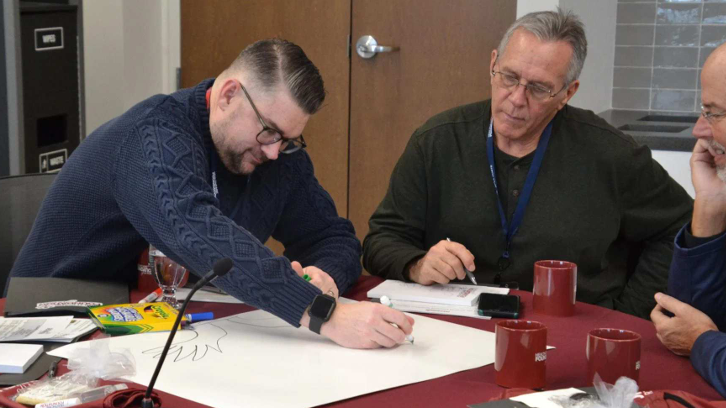
Pastor Nate Loucks, CEO and president of the Pax Center, started the day with an icebreaker, asking participants to work with others at their table in creating a poster that represented their organizations’ missions and where they intersect.
“During the pandemic, so many of our organizations kind of flipped leadership. Many of our relationships with each other have evolved and our organizations have changed. We want to get to know each other a little bit,” Loucks said.
The symposium featured a bird motif throughout the day – similar to the building’s entryway and part of the event’s theme, Leaders Learn, which came from a quote by Israelmore Ayivor, “Just as the bird needs wings to fly, a leader needs useful information to flow. Leaders learn.”
“When I was decorating the building, I felt strongly, how do we demonstrate – especially among the nonprofit community – that we’re very interested in helping them to grow and be effective. The birds signify the flight and the growth of the not-for-profits,” Fruth said.